
20 May 2026
Open Letter to the President of Lithuania on Belarus Aid Transparency
His Excellency Gitanas Nausėda
President of the Republic of Lithuania
Your Excellency,
We would like to express our sincere gratitude for Your public response to our appeal concerning transparency in the use of international assistance allocated to support Belarus and Belarusian democratic initiatives.
We highly appreciate Your attention to this issue and believe it is important that questions of transparency, accountability, and public oversight have received recognition at the level of the Head of the Lithuanian State. This matters not only for financial integrity, but also for relations between the peoples of Belarus and Lithuania, whose histories remain deeply interconnected. We believe that cooperation between a future democratic Belarus and democratic Lithuania should be built on trust, openness, and mutual respect, free from any perception that the tragedy of Belarus after 2020 became, for some individuals or structures, a source of financial benefit, or monopolization of the representation of Belarusian society abroad.
Many Belarusians developed the perception that certain individuals and groups who were not even present in Belarus during the historic peaceful uprising of 2020, and who bore no personal risks, obtained privileged access to political influence and international financial resources through connections with particular individuals in Lithuania.
As a result, many Belarusians came to believe that, for some of these structures, the continued existence of authoritarian repression became politically and financially beneficial: the worse the situation inside Belarus, the greater the international attention, funding, and influence accumulated abroad. While thousands of people inside Belarus faced imprisonment, torture, destruction of their property and forced exile, others transformed the tragedy of the Belarusian people into political influence and financial gain.
For example, Franak Viačorka, adviser to the so called “Office of Tsikhanouskaya,” who explained his absence from Belarus during the 2020 campaign by saying he was “afraid of shooting,” reportedly received annually around EUR 1 million to his “Infopoint” company, where he was the sole beneficiary, allegedly using these resources to create financial and informational dependency over media outlets, NGOs, bloggers, and civil society initiatives, as well as for personal gain.
Thus, at the very moment when thousands of political prisoners who had fought for Belarus’s future remained behind bars, and lonely mothers who fled persecution with their minor children were literally struggling to survive, he publicly displayed luxury watches worth approximately EUR 7,000 — an amount exceeding the average annual salary in Belarus. In the eyes of many Belarusians, this and similar examples of using foreign assistance deepened divisions within the democratic movement, destroyed trust between Belarusians, and discredited democratic institutions themselves.
This is only one example of a much broader problem: the emergence of a closed system of nontransparent distribution of international assistance. Serious public concerns have also emerged regarding leaks of personal data of Belarusian citizens, which subsequently led to hundreds of arrests, persecution, and criminal proceedings inside Belarus. Among the structures publicly associated with such concerns are “Belarusian Hajun,” “Black Book of Belarus,” and the “Peramoga” plan. At the same time, “Belarus Passport Center” continues to operate on the territory of Lithuania, issuing the so called “New Belarus Passport” and collecting sensitive personal data from individuals, including biometric information.
(Detailed factual materials and publicly available financial information are attached separately for Your consideration).
We believe that misappropriation or nontransparent distribution of funds on such a scale would hardly be possible without the existence of political protection mechanisms. In this regard, significant speculation has emerged within the Belarusian democratic community regarding the connection between the role of former Lithuanian Minister of Foreign Affairs Gabrielius Landsbergis in supervising or politically supporting the above mentioned structures and initiatives and the subsequent purchase by his family of a luxury villa in Greece. The explanation that such assets were acquired exclusively due to the professional success of a spouse raises serious doubts, as history contains numerous examples where educational and charitable initiatives were used as mechanisms for accumulation of private wealth by politically connected families.
Belarusians are well aware that the daughters in law of Alexander Lukashenko, Lilia and Anna Lukashenko, emerged as “highly successful business figures” exercising influence over sectors such as arts, mass media, entertainment, and music. The Nazarbayev family, where the spouse Sara Nazarbayeva and daughter Anara Kulibayeva established elite international schools across Almaty and Astana; In Indonesia “Madame Tien” established the system of educational foundations, kindergartens, and schools, that became associated with opaque financial flows and political patronage; Asma al-Assad, who was widely known of using substantial international assistance allocated for educational initiatives in Syria to strengthen the financial influence of the ruling family. Comparable approaches were also associated with Simone Gbagbo of Ivory Coast, and Grace Mugabe of Zimbabwe, Sandra Torres from Guatemala, Rosario Murillo from Nicaragua, and many others, whose educational and charitable projects were perceived as instruments of family enrichment and political influence.
We would like to emphasize that our appeal is not directed against any individual personally. The issue concerns a broader system of nontransparent distribution of international assistance, which contributed to distrust within the Belarusian democratic movement and coincided with the strengthening of authoritarian repression and the growth in the number of political prisoners.
We highly appreciate Your decision to instruct the Office of the General Prosecutor to investigate the activities of the “Center of Law and Democracy.” We do not seek to make accusations or prejudge anyone’s responsibility. Our only wish is that both Belarusians and Lithuanians know the truth, and that questions related to the use of international assistance, protection of personal data, and possible conflicts of interest receive an objective and transparent assessment.
In this context, we respectfully propose the establishment of an independent international review mechanism involving Lithuanian institutions, relevant European Union bodies, independent auditors, legal experts, civil society and media freedom organizations, as well as representatives of Belarusian democratic society without political discrimination. We believe such a mechanism would strengthen public trust and demonstrate Lithuania’s commitment to openness, fairness, democratic pluralism, and responsible stewardship of international assistance.
Respectfully yours,
Dr. Valery Tsepkalo
Chairman of the Board, Belarus Democratic Forum, former Ambassador to the USA, Founder and CEO Belarus HiTech Park, Presidential Candidate 2020
Dmitry Bolkunets
Belarus Democratic Forum
P.S. On May 19, 2026, voting concluded for the so-called “Coordination Council,” another example that became associated with misuse of foreign assistance, whose previous chairperson misappropriated approximately EUR 150,000 allegedly used to purchase an apartment in Minsk.
According to publicly available figures, only around 2,000 people out of approximately 7 million eligible Belarusian voters participated in the elections, despite extensive promotion, paid advertising campaigns, the involvement of well known Russian bloggers, and repeated appeals by Ms. Tsikhanouskaya, her office, and affiliated structures.
These results reflect the actual level of public support for such fictitious structures and serve as an objective assessment of pseudo democratic organizations claiming to represent Belarusian society. The outcome also raises serious questions regarding the effectiveness, accountability, and use of the hundreds of millions of euros and dollars allocated by European and American taxpayers to support Belarusian democratic initiatives, which we respectfully call upon You, Mr. President, to help clarify before the Belarusian, Lithuanian, European, and American public.
Encl.:
- Additional Information on Organizations Operating in Lithuania
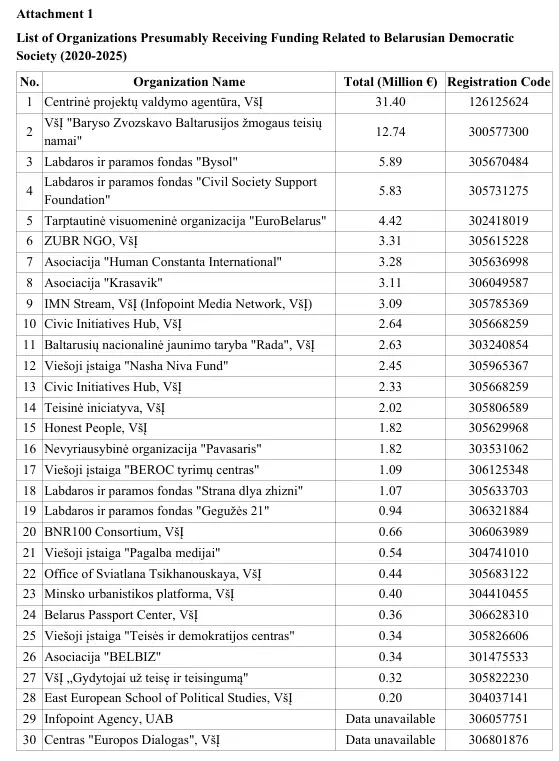
- Table of Organizations Presumably Receiving Funding Related to Belarusian Democratic Society (2020-2025)
Attachment 1
Additional Information on Organizations Operating in Lithuania
In particular, we respectfully request consideration of an independent investigation into the activities of organizations operating in Lithuania that were allegedly connected with leaks of personal data belonging to Belarusian citizens, which subsequently led to arrests, interrogations, persecution, and criminal proceedings against hundreds of individuals inside Belarus.
Among the structures raising serious public concern are “Belarusian Hajun”; “Black Book of Belarus”; and the “Peramoga” plan and related initiatives.
We believe it is necessary to establish:
- what mechanisms of data protection and verification existed;
- whether Lithuanian or European legal standards regarding personal data protection were properly respected;
- whether international donor funds were directly or indirectly used in activities that created risks for Belarusian citizens inside Belarus.
We also respectfully ask You to pay attention to the activities of Belarus Passport Center, VšĮ (code 306628310), which according to publicly available information received at least EUR 363,000, including no less than EUR 219,827 from Civil Society Support Foundation (code 305731275). The very concept of structures issuing so called “New Belarus Passports,” collecting sensitive personal data of Belarusian citizens, and operating outside internationally recognized state frameworks raises serious legal, political, and security concerns which, in our opinion, require proper institutional assessment.
According to publicly available information, IMN Stream, VšĮ (former name Infopoint Media Network, VšĮ, code 305785369), established by Franak Viačorka, received at least EUR 3 million through Lithuanian accounts alone. There are serious concerns that resources distributed through structures connected with the so called “Office of Tsikhanouskaya” were used for establishing mechanisms of financial and informational dependency over media outlets, NGOs, bloggers, and civil society initiatives through NDA agreements and other restrictive arrangements incompatible with the principles of media independence, pluralism, freedom of expression, and democratic accountability. Particular concern is raised by the fact that such agreements imposed financial penalties of up to EUR 30,000 on organizations or individuals failing to follow political instructions issued by the Office structures. In our opinion, such practices require legal and democratic assessment regarding their compatibility with European principles of free expression, independent media, and political pluralism.
Special attention, in our opinion, should also be paid to the activities of the foundation BYSOL (Labdaros ir paramos fondas BYSOL, code 305670484), which, according to public reporting, received more than EUR 5.8 million intended for the support of political prisoners. At the same time, the founder of the organization became involved in a public scandal following accusations by Belarusian activists concerning the sending of unsolicited intimate photographs, incidents which he subsequently acknowledged publicly.
Given the scale of public fundraising and international donor support involved, we believe that independent financial and governance audits of such organizations would serve not only the interests of transparency, but also the long-term credibility of Lithuanian support for democratic Belarus.
Also of particular concern is the case of “Belarusian Hajun,” referenced in the report of BNR100 Consortium, VšĮ (code 306063989). The compromise of leaked data reportedly resulted in mass arrests in Belarus.
We also respectfully note that the organization Civil Society Support Foundation, through its first director, Lithuanian citizen Miroslavas Monkevičius, was connected with Office of Sviatlana Tsikhanouskaya, VšĮ (code 305683122), where he also served as director. According to publicly available reports, this organization received no less than EUR 5.8 million.
Such a process could also become an important foundation for future relations between democratic Belarus and Lithuania, helping to remove distrust, speculation, and perceptions of political or financial monopolization surrounding the representation of Belarusian society abroad.
Attachment 2 contains a preliminary, but non-exhaustive, Table of Organizations Presumably Receiving Funding Related to Belarusian Democratic Society (2020-2025).
Note
The data presented in this table were compiled from publicly available information published on the official website of the Lithuanian Centre of Registers (registrucentras.lt).
The reported amounts cover the period from 2020 to 2025. However, financial statements for 2025 have not yet been published for the majority of the organizations listed.
This table represents a preliminary and non-exhaustive list of organizations presumably involved in activities related to support for Belarusian democratic society. The table may contain typographical errors or inaccuracies in the reported financial amounts due to inconsistencies in publicly available registry records.
Some organizations may have incomplete, missing, or inaccessible financial reporting in the public domain. Financial statements were unavailable, among others, for Infopoint Agency, UAB (Registration Code: 306057751) and Centras "Europos Dialogas", VšĮ (Registration Code: 306801876).