
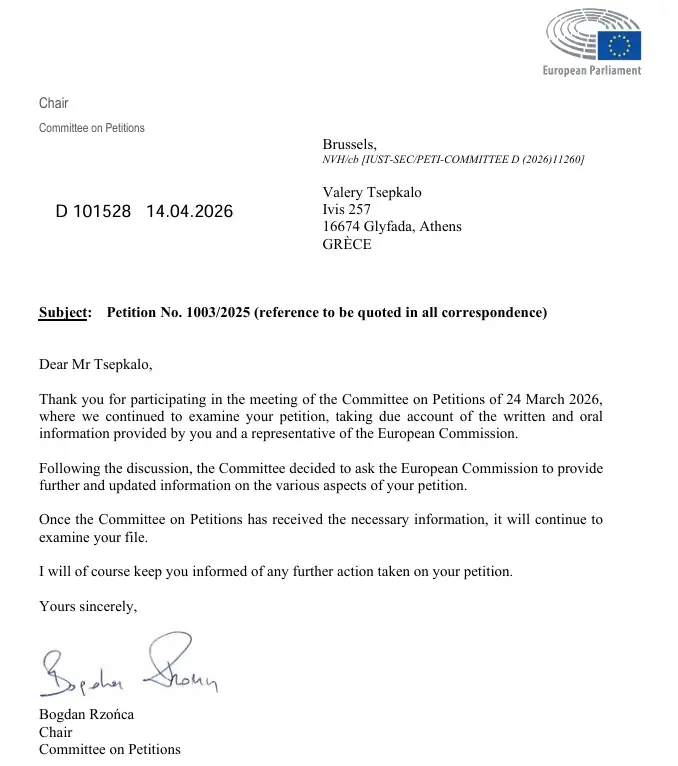
The European Parliament’s Committee on Petitions has decided to request additional information from the European Commission regarding Petition No. 1003/2025, submitted by Valery Tsepkalo. This is stated in an official letter from Committee Chair Bogdan Rzońca dated April 14, 2026.
The matter had previously been discussed at a committee meeting on March 24, 2026. Following the debate, Members of the European Parliament concluded that more detailed and updated clarifications were needed from the Commission on several key aspects of the case. The examination of the petition will continue once the requested information is received.
Nature of the Concerns
In his latest submission, the petitioner emphasizes that the case raises systemic issues related to the application of European Union law. These include equality before the law, the effectiveness of EU sanctions policy, and the conduct of major financial institutions in authoritarian environments.
Particular attention is given to the role of Raiffeisen Bank International, which, according to the petitioner, remains one of the key channels for international financial transactions linked to Russia, despite EU sanctions imposed after 2022.
Questions to the European Commission
The petitioner calls on the European Commission to provide clear and specific answers to several questions, including:
whether the role of certain banks in facilitating or mitigating sanctions circumvention is being assessed;
how consistently EU restrictive measures are being applied;
whether human rights risks are taken into account in the operations of European companies in Belarus following the events of 2020;
whether there is a risk of distortion of competition within the EU internal market due to unequal regulatory approaches.
The petitioner also points to a possible inconsistency between the actions of certain companies and the fundamental principles of EU law, including equality and non-discrimination.
Next Steps
The Committee on Petitions has confirmed that the case remains open and under active consideration. Members of the European Parliament will return to the issue once the European Commission provides its response.
The petitioner, in turn, has urged the Committee to continue its work until a “clear and verifiable” answer is obtained, stressing that the case concerns not only a specific situation but also the overall credibility of European institutions.
---
April 15, 2026
To:
Committee on Petitions
European Parliament
Re: Petition No. 1003/2025 — Follow-up submission after PETI meeting of 24 March 2026
Dear Mr. Chair,
Dear Members of the Committee on Petitions,
I write further to the meeting of the Committee on Petitions of 24 March 2026, and to the Chair’s letter of 14 April 2026 informing me that the Committee has decided to request further and updated information from the European Commission regarding the various aspects of my petition.
I respectfully submit this follow-up in order to assist the Committee in identifying the core legal and systemic issues that, in my view, require a clear, specific, and verifiable response from the Commission.
1. Nature of the petition: systemic EU law concerns
This petition raises questions of:
equal application of EU law,
credibility and effectiveness of EU sanctions,
corporate conduct in high-risk authoritarian environments, and
consistency of regulatory oversight within the internal market.
At its core, the case concerns whether a major EU-based financial institution may maintain a structurally significant role in jurisdictions associated with repression and aggression, while not being subject to scrutiny or regulatory response commensurate with that role.
The issue therefore engages not only individual rights, but the integrity and coherence of Union law as a whole.
2. Equal treatment and non-discrimination in the application of EU law
A central question raised by the petition is whether EU law is being applied consistently and without discriminatory effect, in line with:
Article 18 TFEU,
Articles 20 and 21 of the Charter of Fundamental Rights, and
general principles of equal treatment, proportionality, and legal certainty.
In particular, the apparent inconsistency in the application of EU restrictive measures is illustrated by the contrast between:
individuals associated with financial institutions playing a limited or diminishing role in cross-border financial flows who have nevertheless been subject to restrictive measures; and
the absence of comparable scrutiny or measures in relation to actors associated with a financial institution that continues to function as a principal channel for international financial transactions linked to the Russian Federation.
This raises a fundamental question as to the objective criteria governing EU sanctions policy, and whether those criteria are applied in a consistent and non-discriminatory manner.
The credibility of EU law depends not only on its formal adoption, but on its consistent application. Where restrictive measures are applied rigorously to some actors yet appear attenuated in relation to others with significantly greater systemic impact, this risks creating the perception of a dual standard — one based on principle, another on convenience.
3. Sanctions credibility, circumvention risks, and Treaty obligations
The petition raises a structural concern regarding the credibility and effectiveness of EU restrictive measures adopted under:
Article 29 TEU, and
implemented under Article 215 TFEU.
Following the withdrawal of many European and international financial institutions after February 2022, Raiffeisen Bank International has remained one of the principal financial channels for cross-border transactions involving the Russian Federation, servicing a large client base and facilitating significant financial flows.
In this context, the Commission is respectfully requested to clarify:
whether it has assessed the systemic role of such an institution in enabling or sustaining cross-border financial flows linked to a state subject to EU restrictive measures;
whether it has evaluated the risk of indirect facilitation or circumvention, including through re-routing, intermediary structures, or continued large-scale operations;
how it ensures, in accordance with Article 17 TEU, that EU sanctions are applied effectively, uniformly, and without structural loopholes.
A sanctions framework that is robust in formal design but permits the emergence of a single dominant financial conduit risks undermining both its legal coherence and its strategic purpose.
4. Human rights due diligence and conduct in high-risk environments
The petition further raises concerns regarding the conduct of an EU-based financial institution in a high-risk human rights environment, including Belarus following the 2020 crackdown on civil society.
In particular, the issues concern:
exposure to property confiscation processes affecting politically exposed individuals,
the adequacy of measures taken to identify, prevent, and mitigate human rights risks, and
the extent to which the institution acted in line with:
the UN Guiding Principles on Business and Human Rights,
the OECD Guidelines for Multinational Enterprises, and
the evolving EU framework on corporate due diligence (including Directive (EU) 2024/1760).
The Commission is respectfully requested to clarify:
whether it has assessed the conduct described in the petition from the perspective of adverse human rights impact and corporate responsibility;
whether any review was undertaken as to the adequacy of risk mitigation measures;
if no such assessment was carried out, how this is reconciled with the Union’s commitment to human rights and rule of law in its external and internal policies.
5. Internal market integrity and regulatory consistency
The issues raised also engage the functioning of the internal market.
Where a single financial institution is, in practice, permitted to maintain or expand a structurally advantageous position under conditions where others have exited or been restricted, this raises questions as to:
regulatory asymmetry,
potential distortion of competition, and
the consistency of enforcement in relation to Articles 101 and 102 TFEU.
The Commission is therefore invited to clarify whether it has assessed:
the impact of such asymmetries on the internal market;
whether supervisory or enforcement approaches are being applied consistently across comparable situations;
what safeguards exist to ensure that economic scale or systemic relevance does not result in reduced scrutiny.
6. Requirement for a concrete and non-generic Commission response
In light of the above, I respectfully request that the Committee ensure that the Commission provides a specific, structured, and non-generic reply, including:
identification of the services (Directorates-General) involved in the assessment;
the legal frameworks applied;
whether any review, inquiry, or supervisory action was undertaken;
clear conclusions as to the compatibility of the conduct described with:
EU sanctions objectives,
principles of equal treatment, and
the Union’s human rights commitments.
A response limited to general institutional explanations would not adequately address the substance of the petition.
7. Importance of continued examination
The Committee’s decision to seek further information from the Commission confirms that the issues raised are neither resolved nor marginal.
This case raises a broader question of institutional credibility: whether Union law is applied uniformly across actors, or whether its intensity varies depending on economic or systemic considerations.
I therefore respectfully request that the Committee:
maintain the petition under active consideration; and
continue its examination until a clear and verifiable position is provided by the Commission.
I remain at the Committee’s disposal for any further clarification or supporting documentation.
Yours faithfully,
Dr Valery Tsepkalo
Petitioner
Petition No. 1003/2025