His Excellency Gitanas Nausėda
President of the Republic of Lithuania
Your Excellency,
We would like to express our sincere gratitude for Your public response to our appeal concerning transparency in the use of international assistance allocated to support Belarus and Belarusian democratic initiatives.
At the same time, we have not received a response to the letter addressed to You on May 20. Therefore, we are sending an updated appeal together with an expanded list of organizations that we have been able to identify through our research. The majority of the structures on this list are entirely unknown to us; we learned of their existence for the first time from financial reports.
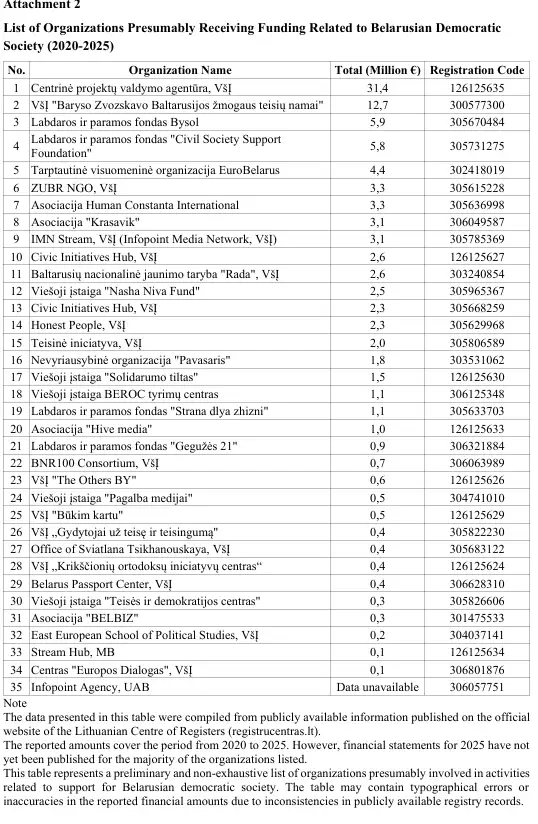
According to our preliminary estimates, more than €100 million in international assistance intended to support Belarus and Belarusian civil society has been channeled through organizations registered in Lithuania. At the same time, the public reporting of a number of these structures raises serious concerns. There are grounds to believe that, in several cases, shell companies were established, the activities of some of them may have been fictitious, and significant abuses or even large-scale fraud involving grant funds intended for the people of Belarus may have occurred. In many instances, despite huge amounts of funding having been transferred to the accounts of these organizations, there is a complete absence of publicly available information regarding the public activities and track record of their directors. In the course of our analysis, we identified indications of the use of short-lived shell companies. Specifically, certain organizations were liquidated immediately after absorbing the allocated grants. In international risk management practice, this constitutes a classic red flag for financial malpractice and the laundering of illicit funds.
We highly appreciate Your attention to this issue and believe it is important that questions of transparency, accountability, and public oversight have received recognition at the level of the Head of the Lithuanian State. This matters not only for financial integrity, but also for relations between the peoples of Belarus and Lithuania, whose histories remain deeply interconnected. We believe that cooperation between a future democratic Belarus and democratic Lithuania should be built on trust, openness, and mutual respect, free from any perception that the tragedy of Belarus after 2020 became, for some individuals or structures, a source of financial benefit or a means to monopolize the representation of Belarusian society abroad.
Many Belarusians developed the perception that certain individuals and groups who were not even present in Belarus during the historic peaceful uprising of 2020, and who bore no personal risks, obtained privileged access to political influence and international financial resources through connections with particular individuals in Lithuania.
As a result, many Belarusians came to believe that, for some of these structures, the continued existence of authoritarian repression became politically and financially beneficial: the worse the situation inside Belarus, the greater the international attention, funding, and influence accumulated abroad. While thousands of people inside the country faced imprisonment, torture, destruction of their property, and forced exile, others transformed the tragedy of the Belarusian people into an instrument of political influence and financial gain.
Despite the more than €200 million allocated by the European Union to support Belarusian democratic initiatives in recent years, no democratic progress has been achieved inside Belarus. On the contrary, this assistance not only failed to halt the repressions or facilitate the release of political prisoners, but inadvertently contributed to the creation of new ones, due to massive leaks of sensitive personal data from structures established in Lithuania. As a result, democratic institutions have been thoroughly discredited in the eyes of the majority of Belarusians, while authoritarian control within the country has only intensified.
We succeeded in building an international humanitarian network that brought together 75 Nobel laureates, who signed several joint appeals calling for the release of Belarusian political prisoners. These efforts helped bring the humanitarian situation in Belarus to the attention of the White House administration and personally President Donald Trump. As a result of this process, more than 500 people have already been released from Belarusian prisons. Our humanitarian work was carried out strictly on a voluntary and non-profit basis. We used our own funds to organize meetings with Nobel laureates and to cover travel, accommodation, and other humanitarian expenses. Our primary objective has always been the saving of human lives and the release of individuals from captivity, rather than political gain.
Unfortunately, during this period, a number of organizations and media structures registered in Lithuania and funded by European resources publicly attacked and attempted to discredit our humanitarian and negotiation-based approaches, despite the fact that it was precisely these efforts that ultimately contributed to the release of hundreds of prisoners. This left many Belarusians with the impression that, for certain structures, the very existence of political prisoners in Belarus has become closely tied to maintaining their own political relevance, public attention, and financial support.
Serious public concerns have also emerged regarding leaks of personal data of Belarusian citizens, which subsequently led to hundreds of arrests, persecution, and criminal proceedings inside Belarus. Among the structures publicly associated with such incidents are "Belarusian Hajun," "Black Book of Belarus," and the "Peramoga" plan. At the same time, the "Belarus Passport Center" continues to operate on the territory of Lithuania, issuing the so-called "New Belarus Passport" and collecting sensitive personal data from individuals, including biometric information. In response to one of our appeals regarding the massive data leaks that resulted in subsequent arrests, the Lithuanian Prosecutor's Office provided an absurd reply, advising the affected and arrested Belarusian citizens to contact 'the law enforcement authorities of the Republic of Belarus.'
(Detailed factual materials and publicly available financial information are attached separately for Your consideration).
We believe that the misappropriation or nontransparent distribution of funds on such a scale would hardly be possible without the existence of political protection mechanisms.
We would like to emphasize that our appeal is not directed against any specific individual. The issue concerns a broader system of nontransparent distribution of international assistance, which contributed to growing distrust within the Belarusian democratic movement and coincided with the strengthening of authoritarian repression and the rising number of political prisoners.
We highly appreciate Your decision to instruct the Office of the General Prosecutor to investigate the activities of the "Center of Law and Democracy." We do not seek to make accusations or prejudge anyone’s responsibility. Our only wish is that both Belarusians and Lithuanians know the truth, and that questions related to the use of international assistance, the protection of personal data, and possible conflicts of interest receive an objective and transparent assessment.
Given the public importance of this matter, we trust that You will give careful consideration to the facts presented, take this situation under Your personal supervision, and ensure that an independent and comprehensive review of the use of grant assistance routed through Lithuania is conducted. We are sending a parallel request to OLAF (the European Anti-Fraud Office) and the relevant oversight bodies in the United States authorized to audit American assistance to the people of Belarus.
In this context, we respectfully propose the establishment of an independent international review mechanism involving Lithuanian institutions, relevant European Union bodies, independent auditors, civil society and media freedom organizations, as well as representatives of Belarusian democratic society without political discrimination. We believe such a mechanism would strengthen public trust and demonstrate Lithuania’s commitment to openness, fairness, democratic pluralism, and responsible stewardship of international assistance.
Respectfully yours,
Dr. Valery Tsepkalo
Chairman of the Board, Belarus Democratic Forum, former Ambassador to the USA, Founder and CEO Belarus HiTech Park, Presidential Candidate 2020
Dmitry Bolkunets
Secretary General, Belarus Democratic Forum
Encl.:
- Additional Information on Organizations Operating in Lithuania
- Table of Organizations Presumably Receiving Funding Related to Belarusian Democratic Society (2020-2025)
Attachment 1
Additional Information on Organizations Operating in Lithuania
In particular, we respectfully request consideration of an independent investigation into the activities of organizations operating in Lithuania that were allegedly connected with leaks of personal data belonging to Belarusian citizens, which subsequently led to arrests, interrogations, persecution, and criminal proceedings against hundreds of individuals inside Belarus.
Among the structures raising serious public concern are “Belarusian Hajun”; “Black Book of Belarus”; and the “Peramoga” plan and related initiatives.
We believe it is necessary to establish:
what mechanisms of data protection and verification existed;
whether Lithuanian or European legal standards regarding personal data protection were properly respected;
whether international donor funds were directly or indirectly used in activities that created risks for Belarusian citizens inside Belarus.
We also respectfully ask You to pay attention to the activities of Belarus Passport Center, VšĮ (code 306628310), which according to publicly available information received at least EUR 363,000, including no less than EUR 219,827 from Civil Society Support Foundation (code 305731275). The very concept of structures issuing so called “New Belarus Passports,” collecting sensitive personal data of Belarusian citizens, and operating outside internationally recognized state frameworks raises serious legal, political, and security concerns which, in our opinion, require proper institutional assessment.
According to publicly available information, IMN Stream, VšĮ (former name Infopoint Media Network, VšĮ, code 305785369), established by Franak Viačorka, received at least EUR 3 million through Lithuanian accounts alone. There are serious concerns that resources distributed through structures connected with the so called “Office of Tsikhanouskaya” were used for establishing mechanisms of financial and informational dependency over media outlets, NGOs, bloggers, and civil society initiatives through NDA agreements and other restrictive arrangements incompatible with the principles of media independence, pluralism, freedom of expression, and democratic accountability. Particular concern is raised by the fact that such agreements imposed financial penalties of up to EUR 30,000 on organizations or individuals failing to follow political instructions issued by the Office structures. In our opinion, such practices require legal and democratic assessment regarding their compatibility with European principles of free expression, independent media, and political pluralism.
Special attention, in our opinion, should also be paid to the activities of the foundation BYSOL (Labdaros ir paramos fondas BYSOL, code 305670484), which, according to public reporting, received more than EUR 5.8 million intended for the support of political prisoners. At the same time, the founder of the organization became involved in a public scandal following accusations by Belarusian activists concerning the sending of unsolicited intimate photographs, incidents which he subsequently acknowledged publicly.
Given the scale of public fundraising and international donor support involved, we believe that independent financial and governance audits of such organizations would serve not only the interests of transparency, but also the long-term credibility of Lithuanian support for democratic Belarus.
Also of particular concern is the case of “Belarusian Hajun,” referenced in the report of BNR100 Consortium, VšĮ (code 306063989). The compromise of leaked data reportedly resulted in mass arrests in Belarus.
We also respectfully note that the organization Civil Society Support Foundation, through its first director, Lithuanian citizen Miroslavas Monkevičius, was connected with Office of Sviatlana Tsikhanouskaya, VšĮ (code 305683122), where he also served as director. According to publicly available reports, this organization received no less than EUR 5.8 million.
Human Constanta International Association (registration code 305636998). Between 2020 and 2024, the organization received more than €3.3 million in grant funding. However, according to its official financial reports, the average number of employees throughout this period was zero, and no salary expenses were reported. Volunteer activity also appears to have been minimal. In 2024, the organization reported only five volunteers contributing a total of 300 hours, while in previous years the figures were even lower. A substantial portion of the materials published on the organization's website consists of compilations of publicly available sources. Furthermore, one of its reports explicitly states that ChatGPT was used in the preparation of the text. The significant discrepancy identified between the volume of funding received and the organization's actual operational resources raises concerns that its activities may be largely formal in nature and that the organization may have been used as a vehicle for the improper or ineffective utilization of grant funds.
These are only a few examples. In this situation, an international audit could also serve as an important foundation for future relations between democratic Belarus and Lithuania, helping to eliminate distrust, speculation, and perceptions that the representation of Belarusian society abroad has become politically or financially monopolized.